INTRODUCTION
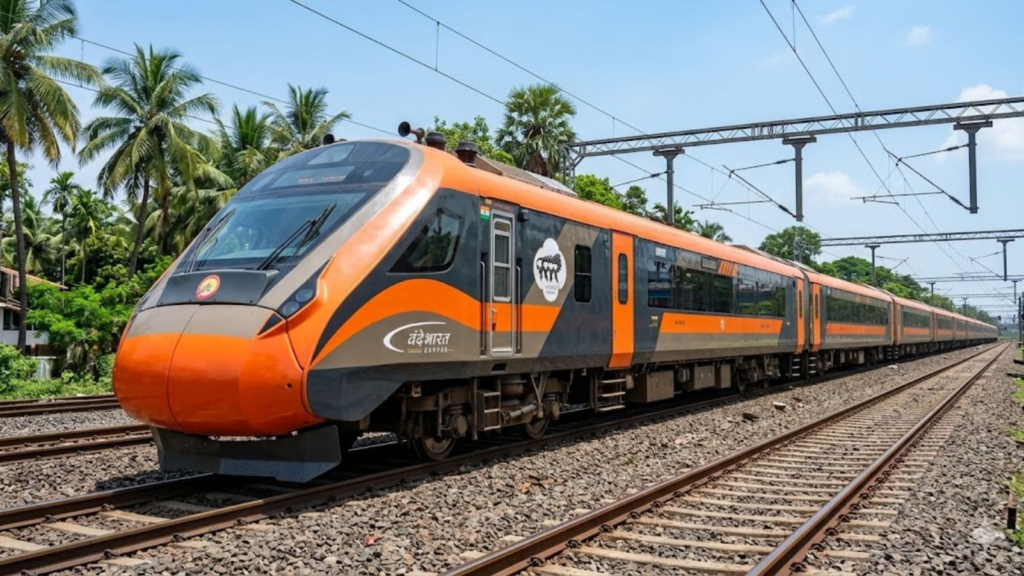
The Vande Bharat Sleeper represents a milestone in semi-high-speed overnight rail travel, operating at design speeds up to 180 km/h.
To ensure maximum passenger safety and structural integrity under demanding operational conditions, Indian Railways required comprehensive validation of the train’s complete Crash Energy Management (CEM) solution.
CHALLENGE
We were approached by BEML Limited with the challenge to design a 16-coach semi-high-speed sleeper train balancing complex kinetic energy distribution during a collision.
Key Technical Challenges included:
- Full-Train Dynamics: Simulating an extensive 16-coach rake requires managing complex multi-body interactions, frame deformations, and longitudinal force transfers across the entire length of the train.
- Multi-Vendor Integration: The couplers and energy-absorbing elements were supplied by an external third-party manufacturer, requiring seamless integration into the digital model.
- Strict International Compliance: The complete train structure needed to meet EN 15227 C-I Category collision scenarios, specifically verifying controlled energy dissipation through the train formation, deceleration rates etc. at 36 km/h.
- Global Regulatory & Design Acceptance: The simulation methodology and results had to demonstrate a high level of technical rigour and transparency to achieve acceptance from BEML engineering stakeholders & European design consultancy, EC Engineering.
SOLUTION
Using DigitalTrains™ our team constructed a high-fidelity Digital Twin of the full Vande Bharat Sleeper trainset.
Key Steps:
- Full-Length Digital Twin Construction: Created an accurate dynamic representation of all 16 coaches, incorporating mass configurations, vehicle stiffness profiles etc.
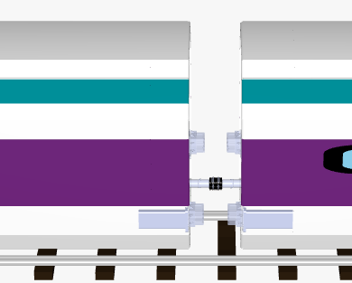
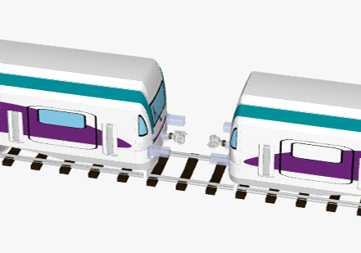
- Coupler & Buffer Integration: Integrated characteristics of third-party couplers and energy absorbers to simulate real-world energy dissipation across the train formation
- Full-Scale 36 km/h Impact Analysis: Executed full-rake impact scenarios aligned with EN 15227 guidelines.
- Energy Absorption Mapping: Analysed how impact energy transferred through the primary structures, couplers and anti-climbers to ensure controlled energy dissipation & decelerations.
CONCLUSION
- Simulation Acceptance: DigitalTrains™ simulation outputs were submitted to BEML and EC Engineering. The crash performance and Crash Energy Management (CEM) behaviour were successfully accepted in accordance with EN 15227 requirements.
- Accelerated Time-to-Market: Digital validation of the crash performance enabled the customer to reduce design iterations, lower development costs, and avoid the delays associated with full-scale destructive testing.
- Collaborative Digital Engineering: DigitalTrains™ successfully connected the train builder, operator, design consultant and third-party component suppliers through a cloud-based digital twin that gave every stakeholder access to a single, shared
engineering environment.