CHALLENGE
We were approached by Oleo who between 2017 and 2022 had completed the design, manufacture, and installation of 29 Friction Sliding Buffer Stops during Orange Line Phase 1. However, in 2025 the regulatory climate significantly changed after several high profile rail industry incidents across the region. In response, the Thai government launched its most stringent High-Level Safety Audit ever conducted. Oleo were required to re-validate their systems under a drastically elevated safety framework. DigitalTrains™ were appointed to analyse the energy absorption performance of Oleo’s pure friction buffer stops and wheel stops under the different conditions specified by the customer.
APPROACH
To support the audit DigitalTrains™ carried out simulations of Rolling Stock, the Buffer Stops and Wheel Stops. A Digital Twin of the Orange line Extension was modeled into DigitalTrains™ along with all the respective Crash Energy Management (CEM) system which consisted of a Front Coupler, and an Intermediate Interface.
Trains consisted of 3 cars with a total train mass of 230T. For the purpose of the simulations, each vehicle was assumed to be of equal mass 76.67T.
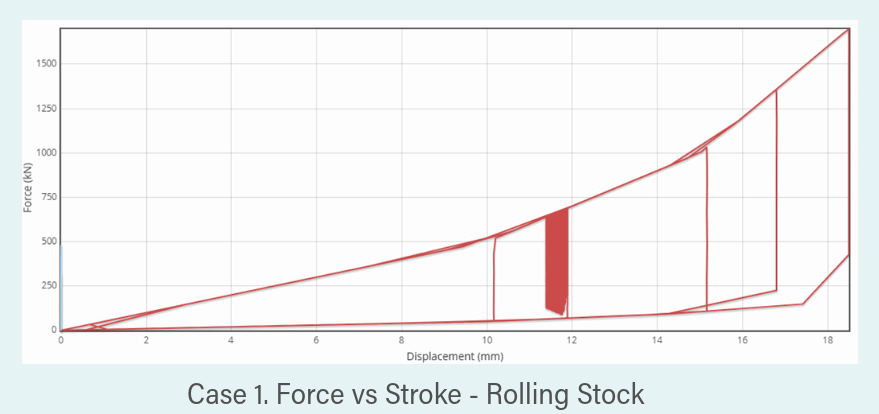
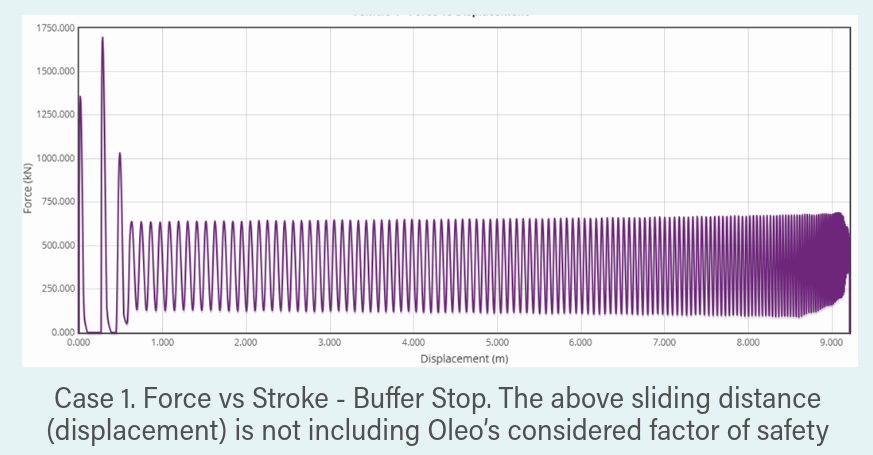
Case 1 – Main Line Dead Ends
Number of friction shoes = 6 working pairs
Impact Velocity: 20 km/h
Buffer Stop Length: 1.717 m
Sliding Distance Including FOS: 12 m
Overall Installation Length: 14.2 m
Max Deceleration: 1.67 m/s2
Nominal Force: 386 kN
Track Up Lift\force: 161 kN Uplift forces are within Oleo’s targeted force of 200 kN
Max Peak Force: 1697.43 kN
The initial impact forces at the coupler were predicted to reach ~1700kN (this peak force would occur for approximately 0.02 seconds) – however no energy absorption within the front coupler was considered, by including the coupler absorption characteristics, it is likely that this force would be reduced
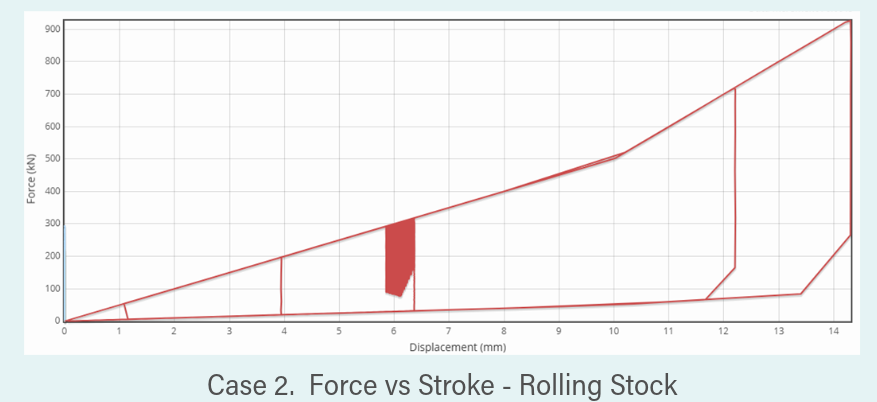
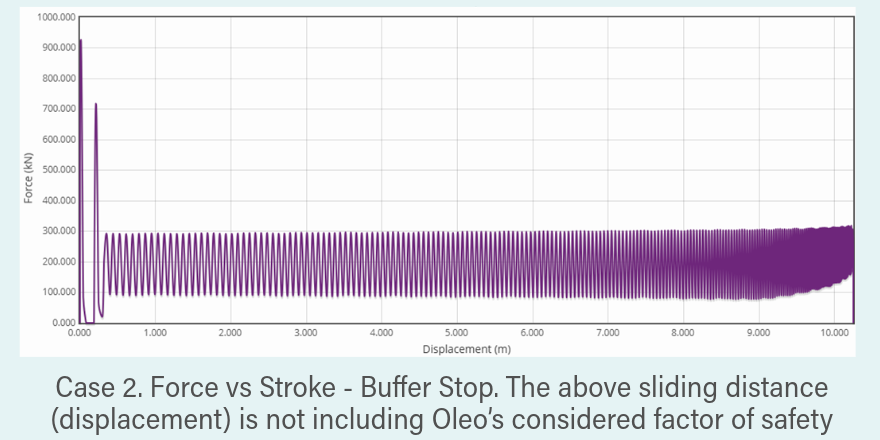
Case 2 – Dept/Stabling Access/Exit Line
Number of friction shoes = 4 working pairs
Impact Velocity: 15 km/h
Buffer Stop Length: 1.717 m
Sliding Distance Including FOS: 10 m
Overall Installation Length: 11.8 m
Max Deceleration: 1.12 m/s2
Nominal Force: 257 kN
Track Up Lift\force: 107 kN Uplift forces are within Oleo’s targeted force of 200 kN
Max Peak Force: 1152.4 kN
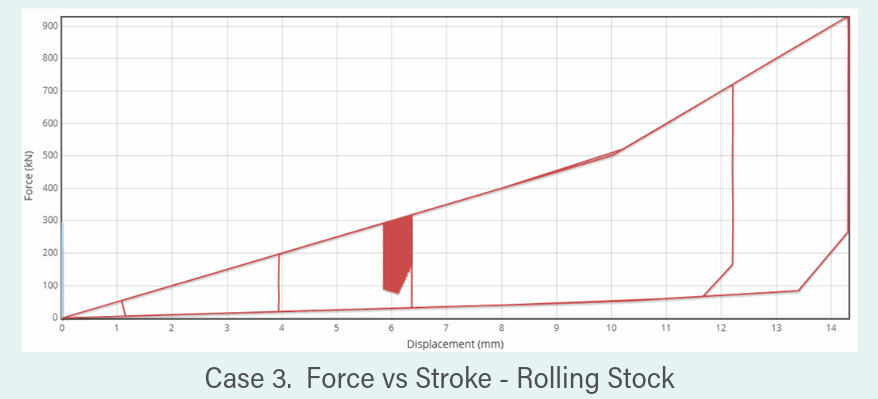
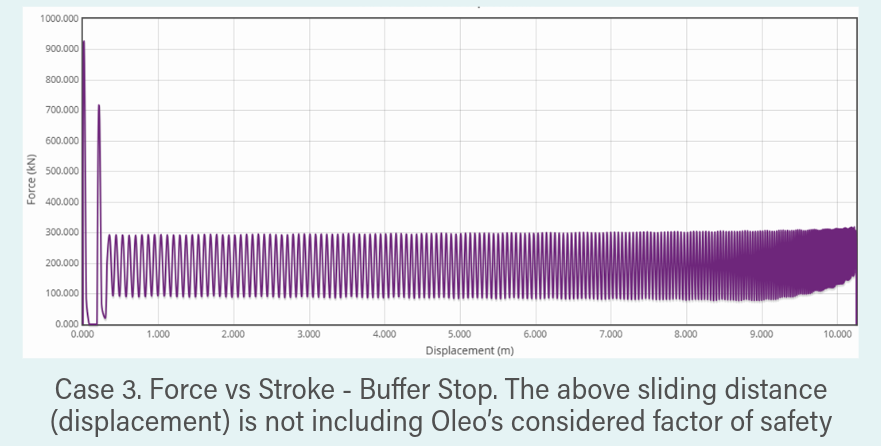
Case 3 – Dept/Stabling Access/Exit Line
Number of friction shoes = 4 working pairs
Impact Velocity: 15 km/h
Buffer Stop Length: 1.717 m
Sliding Distance Including FOS: 10 m
Overall Installation Length: 11.8 m
Max Deceleration: 1.12 m/s2
Nominal Force: 257 kN
Track Up Lift\force: 107 kN Uplift forces are within Oleo’s targeted force of 200 kN
Max Peak Force: 1152.4 kN
Case 4 – Dept/Stabling Access/Exit Line
Impact Speed Whole Train: 6 km/h
Mass of Front Vehicle: 76.67T
Number Wheel Sets on Front Impact Vehicle: 4
Mass on Front Wheel Set: 19.17T
Train Wheel Diameter: 860mm
Number of Friction Shoe Pairs: 1
Sliding Distance: 3049mm Sliding Distance @ FOS = 1.25: 3811mm
Max Peak Force: 926.44 kN
Length of Friction Shoe Pair: 210mm
Length of Wheel Stop Structure: 580mm
Total Installation Length: 4.6m required to stop the train including 25% factor of safety.
Deceleration: 0.45 m/s2
CONCLUSION
From the simulations, it was seen that the Oleo Pure Friction Buffer Stops can fully arrest the impacting train within the allowable 15-metre total installation space for all three scenarios (Case 1 at 20km/h and Case 2/3 at 15km/h). Following the successful audit, Oleo was formally inducted into the Thai Government Whitelist, recognising the company as an approved premium supplier for safety critical rail components. This certification is one of the highest endorsements available for contractors in Thailand’s public transport sector.