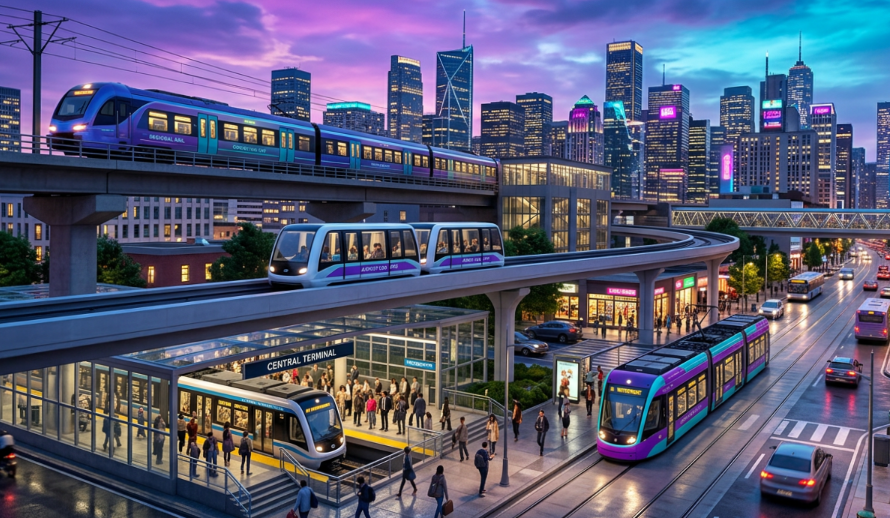
The landscape of global transit is undergoing a massive structural shift. Today’s major transport hubs are no longer defined by a single type of track or a uniform fleet. Instead, modern transit authorities are managing highly complex, hybrid ecosystems.
On any given day, an urban transit network might simultaneously operate a light-rail Tram system weaving through city streets, an Automated People Mover (APM) shuttling passengers between airport terminals, a straddle Monorail bypassing street-level traffic, a high-frequency underground Metro, and heavy Commuter networks or cross-country Freight lines sharing regional corridors.
While this multi-modal approach is fantastic for passenger throughput and economic growth, it presents a monumental headache for mechanical and systems engineers. Why? Because from a physics perspective, different transit types don’t just look different -they behave entirely differently under dynamic stress.
The Engineering Paradox of Multi-Modal Networks
When evaluating vehicle safety, track wear, and ride comfort, there is no such thing as a one-size-fits-all calculation. Every rail architecture introduces unique mechanical forces that must be strictly managed:
- Trams & Light Rail: These vehicles face tight curves in urban centres. This geometry creates intense lateral forces and side-buffer friction, requiring precise modeling of articulation joints and wheel-to-rail wear profiles.
- Monorails & APMs: Operating on elevated concrete guidebeams or specialised tracks, these rubber-tired or unique guidance systems demand customised rolling-chassis and suspension dynamics simulations to guarantee stability and passenger comfort as well as end of line buffer stops.
- Metros & Commuter Lines: Characterised by high passenger density and rapid stop-and-start cycles. Engineers must simulate longitudinal train dynamics to prevent severe passenger jostling during emergency braking or sudden traction changes.
- Heavy Freight: With massive train lengths and extreme tonnages, freight operations are subject to immense draft and buff forces. Miscalculating coupler or buffer energy absorption over a 100-car formation can lead to catastrophic derailments or component fatigue.
- The Gauging & Clearance Bottleneck: Beyond vehicle dynamics, multi-modal networks constantly wrestle with spatial boundaries. Introducing a wide-body commuter train or an articulation-heavy tram into legacy infrastructure means navigating tunnels, platforms, and trackside structures-built decades ago. Over-conservative, static gauging estimates restrict vehicle capacity and waste valuable space, while accurate kinematic gauging is notoriously complex. Engineers must simulate precise vehicle roll, suspension sway, and track irregularities under dynamic conditions to ensure that a newly designed fleet fits perfectly within its physical corridor, preventing catastrophic structural clashes before production begins.
Historically, validating these diverse rolling stock profiles required swapping between fragmented legacy software systems or relying on over-conservative, static approximations.
Tomorrow’s multi-modal networks demand a more agile, high-fidelity approach: Virtual Prototyping.
Enter DigitalTrains™: One Platform, Infinite Fleet Configurations
DigitalTrains™ was explicitly engineered to break down the silos of rail simulation. Rather than forcing engineers to bend a standard rail model to fit an unorthodox vehicle, the software hosts an extensive, specialised library of global transit types and the ability to upload your own model.
Whether you are designing a sleek, lightweight airport APM or a rugged, heavy-haul freight locomotive, DigitalTrains™ allows you to select the baseline architecture instantly and begin customising.
However, the true power of DigitalTrains™ lies beneath the vehicle shell. It allows engineering teams to layer in component-level physical properties to create a high-fidelity digital twin:
- Tailored Coupling & Buffer Interfaces: You can configure the exact energy absorption layout required for your transit type. For heavy commuter and freight lines, this means integrating advanced Crash Energy Management (CEM) parameters – such as anti-climbers, specific draft gears, and high-capacity leading buffers – to test compliance against strict global safety benchmarks like EN 15227 virtually.
- Detailed Bogie and Suspension Assembly: Users can build complex, multi-body bogie components. You can fine-tune suspension stiffness, damping characteristics, and wheel profiles to predict exactly how a metro car will behave over decades of track irregularities, or how a tram will navigate sharp inner-city junctions.
- Real-World Environmental Scenarios: Once your multi-car formation is digitally built, DigitalTrains™ simulates complex operational conditions, including severe impact scenarios, emergency braking sequences, and high-velocity transit running.
De-Risking the Future of Transport
In an era where transit authorities are expanding rapidly to hit sustainability and capacity targets, the margin for error is razor thin. Discovering a vehicle dynamics issue or an energy-absorption flaw during physical type-testing can stall a project for months and cost millions in structural redesigns.
By leveraging the comprehensive libraries and multi-body dynamic capabilities of DigitalTrains™, manufacturers and operators can virtually prototype any vehicle configuration before cutting a single sheet of steel.
The future of global transit is multi-modal, diverse, and fast-moving. Your simulation tools should be too.